


The newsletter business has evolved from a simple email communication tool into a sophisticated revenue-generating model that powers independent creators, media companies, and enterprise brands alike. As traditional media continues to fragment and audiences seek curated, direct-to-inbox content, newsletters have emerged as one of the most reliable ways to build sustainable audience relationships and diversified income streams. In 2026, the landscape offers unprecedented opportunities for those who understand the mechanics of audience development, monetization, and engagement.
The Modern Newsletter Business Landscape
The newsletter industry has matured significantly over the past five years. What began as a trend among tech writers and political commentators has become a full-fledged business model across every conceivable niche. According to recent email newsletter usage data, a substantial portion of American adults now regularly consume news and information through email newsletters, with younger demographics showing increasing adoption rates.
This shift reflects broader changes in how audiences consume content. Social media algorithms have become less predictable, search engine optimization grows more competitive, and readers increasingly value direct relationships with trusted sources. The newsletter business model addresses all these challenges by creating a owned media channel that no platform can take away.
Key Industry Trends Shaping 2026
Several dynamics are reshaping the newsletter business this year:
- Premium subscription models have normalized across industries beyond media and finance
- Niche specialization outperforms general-interest publications in engagement and revenue
- Community features integrated with newsletters drive retention and willingness to pay
- Podcast and video integration expand content formats within email frameworks
- Advanced segmentation allows personalized content delivery at scale
The State of Email 2026 highlights how personalization and mobile optimization have become table stakes rather than competitive advantages. Newsletter operators who fail to meet these baseline expectations struggle with engagement regardless of content quality.
Building Your Newsletter Foundation
Success in the newsletter business starts with strategic foundation-building rather than simply launching an email list. The most successful operators treat newsletters as products requiring market research, positioning, and ongoing optimization.
Audience Definition and Market Research
Before writing your first issue, identify your specific audience and their unmet needs. The newsletter business rewards depth over breadth. A highly engaged audience of 5,000 subscribers in a specific niche generates more revenue and opportunity than 50,000 loosely interested readers.
Research your competitive landscape thoroughly. What newsletters already serve your target audience? Where are the gaps in coverage, perspective, or format? Your unique value proposition must be immediately clear to potential subscribers who receive dozens of newsletters weekly.
Consider these positioning questions:
- What specific problem does your newsletter solve?
- Who is your ideal subscriber, and what are their daily challenges?
- What unique perspective, access, or expertise do you bring?
- How does your newsletter fit into your audience's workflow?
- What action do you want readers to take after each issue?
Platform and Infrastructure Decisions
Choosing the right platform significantly impacts your newsletter business trajectory. The market has consolidated around several major players, each with distinct strengths.
| Platform Category | Best For | Key Considerations |
|---|---|---|
| Creator-focused platforms | Independent writers, simple monetization | Built-in discovery, payment processing, limited customization |
| Email marketing platforms | Established businesses, complex automation | Maximum flexibility, steeper learning curve, separate payment systems |
| Media-specific platforms | Publishers, newsrooms | Editorial workflows, team collaboration, analytics depth |
Your platform choice should align with your growth timeline and monetization strategy. Newsletter businesses focused on rapid paid subscriber growth often benefit from platforms with built-in payment infrastructure and discovery features. Those building newsletters as part of larger media operations typically require more sophisticated automation and integration capabilities.
Technical infrastructure extends beyond your email platform. Consider your content management workflow, subscriber data management, analytics tracking, and compliance requirements from day one. The CAN-SPAM Act compliance requirements establish baseline legal obligations for commercial email that every newsletter business must meet.
Content Strategy and Production
The newsletter business lives or dies on content quality and consistency. Unlike social media, where algorithms can amplify exceptional posts, newsletters require sustained excellence to maintain subscriber growth and engagement.
Editorial Rhythm and Content Mix
Successful newsletter businesses establish predictable publishing rhythms that become habit-forming for readers. Whether daily, weekly, or monthly, consistency builds trust and anticipation. Your frequency should match both your production capacity and your audience's consumption preferences.
Most thriving newsletters employ a consistent content structure that readers recognize immediately:
- Opening hook that establishes relevance and urgency
- Core content delivering promised value (analysis, curation, original reporting)
- Secondary features like recommendations, community highlights, or quick takes
- Clear calls-to-action appropriate to your monetization model
Content differentiation matters enormously in crowded markets. Some newsletter businesses succeed through original reporting and exclusive information. Others win by offering superior curation and synthesis of existing information. Still others build value through distinctive voice, perspective, or community access.

Writing for the Inbox
Email newsletters demand different writing approaches than web articles or social posts. Readers scan newsletters quickly, often on mobile devices, while managing overflowing inboxes. Your writing must respect their time and attention.
Apply these inbox-optimized techniques:
- Front-load value in subject lines and opening paragraphs
- Use scannable formatting with short paragraphs, subheadings, and bullet points
- Write conversationally as though addressing a colleague or friend
- Include clear section breaks to help readers navigate long issues
- End with specific next steps rather than trailing off
Subject lines deserve particular attention. They function as your primary discovery mechanism for existing subscribers and determine whether your carefully crafted content gets read. Test different approaches: questions, numbers, curiosity gaps, and direct benefit statements all work in different contexts.
Monetization Models and Revenue Strategy
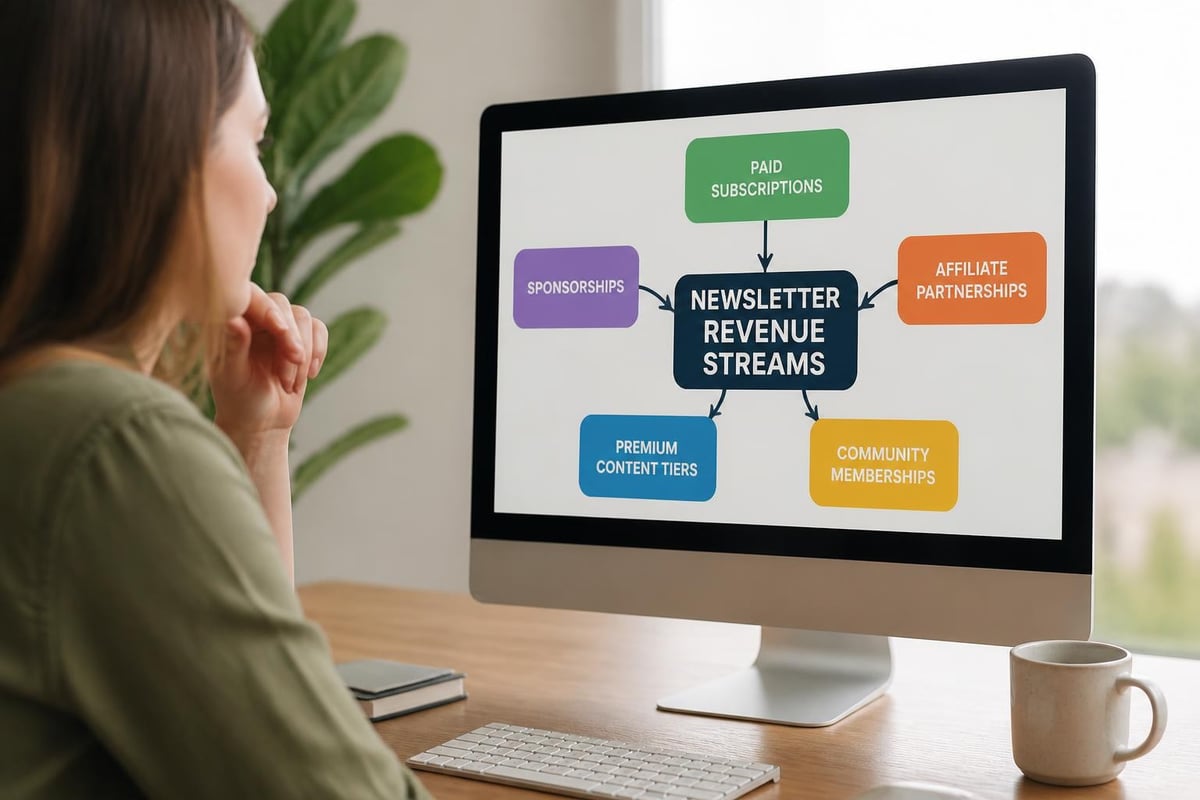
The newsletter business supports multiple revenue streams, and the most successful operators typically combine several approaches. Relying on a single income source creates unnecessary risk and limits growth potential.
Subscription Revenue
Paid subscriptions remain the most direct path to meaningful newsletter revenue. The subscription model aligns incentives perfectly: you create value, readers pay for access, and no third-party dependencies exist.
Subscription pricing requires careful market calibration. Research from Harvard Business Review on newsletter subscription strategies suggests that pricing psychology matters more than absolute dollar amounts. Monthly subscriptions priced between $5 and $15 capture the broadest market, while annual plans (typically offering two months free) improve retention and cash flow.
The freemium model-offering partial content free while reserving premium analysis for paying subscribers-has become the dominant approach in the newsletter business. This strategy builds audience scale while converting engaged readers to paid subscribers. Your free content must deliver genuine value while making the premium tier's additional benefits obvious and compelling.
| Monetization Model | Revenue Potential | Implementation Complexity | Audience Size Required |
|---|---|---|---|
| Paid subscriptions | High | Medium | 1,000+ engaged readers |
| Sponsorships | Medium-High | Low-Medium | 5,000+ subscribers |
| Affiliate partnerships | Low-Medium | Low | 2,000+ subscribers |
| Premium community access | Medium | High | 500+ highly engaged |
| Courses/products | High | High | Varies by offering |
Sponsorship and Advertising
Sponsorships provide revenue without requiring readers to pay, making them attractive for newsletter businesses building free audience scale. However, sponsorship revenue demands substantially larger audiences than subscriptions to generate comparable income.
The newsletter business sponsorship market has matured, with specialized agencies and networks connecting publishers with advertisers. Rates vary dramatically by niche, engagement levels, and audience demographics. Business, finance, and technology newsletters command premium rates, while general-interest publications typically earn less per subscriber.
Maintaining editorial integrity while accepting sponsorships requires clear boundaries. Most successful newsletter businesses limit sponsor content to designated sections, clearly label promotional material, and only accept sponsors aligned with audience interests. Transparency builds trust, which protects the long-term value of your platform.
For publications like Fairmont Post, which covers multiple topics from finance to technology, offering Guest Post opportunities can create an additional revenue stream while providing valuable perspectives to readers when approached thoughtfully.
Audience Growth and Distribution
Growing your newsletter business requires systematic audience development strategies rather than hoping for viral growth. Sustainable newsletter businesses build multiple acquisition channels that compound over time.
Organic Growth Strategies
Search engine optimization drives consistent newsletter signups when you publish valuable web content that ranks well and includes clear subscription calls-to-action. Every article becomes a potential subscriber acquisition channel. Topics covered on platforms like Fairmont Post in fintech and blockchain or personal finance insights naturally attract readers interested in related newsletter content.
Social media serves newsletter growth best when used strategically rather than as your primary distribution channel. Share newsletter excerpts and key insights that demonstrate your value while making subscription easy. Avoid simply posting "new newsletter out" announcements that few will act on.
Word-of-mouth remains the highest-quality acquisition channel for newsletter businesses. Satisfied subscribers who forward issues to colleagues or share on social media bring pre-qualified readers likely to engage and convert. Make sharing effortless with forward-to-friend links and social sharing buttons.
Paid Acquisition and Partnerships
As your newsletter business matures, paid subscriber acquisition often delivers positive return on investment. Platforms offering newsletter discovery features, social media advertising, and cross-promotion with complementary newsletters all merit testing.
Calculate your subscriber lifetime value before investing heavily in acquisition. If the average paid subscriber generates $100 in total revenue and remains subscribed for 18 months, you can profitably spend up to $30-40 acquiring each subscriber while maintaining healthy margins.
Partnership strategies expand reach without direct costs. Cross-promotions with non-competing newsletters in adjacent niches, guest appearances on podcasts, and contributed articles to larger publications all drive qualified traffic. The Nieman Lab’s newsletter industry coverage regularly highlights successful partnership approaches across the media landscape.

Technical Optimization and Deliverability
The best newsletter content delivers zero value if it never reaches subscriber inboxes. Technical optimization ensures your carefully crafted issues actually get delivered and displayed properly.
Email Deliverability Fundamentals
Deliverability-the percentage of emails that reach primary inboxes rather than spam folders-directly impacts newsletter business viability. According to Validity’s 2025 Email Deliverability Benchmark Report, average inbox placement rates hover around 85%, meaning nearly one in six messages never reach their intended audience.
Maintaining strong deliverability requires ongoing attention to several factors:
- Sender reputation built through consistent engagement and low complaint rates
- List hygiene removing inactive subscribers and invalid addresses regularly
- Authentication protocols including SPF, DKIM, and DMARC implementation
- Engagement signals as inbox providers increasingly reward content readers actually open and interact with
Avoid common deliverability mistakes that plague newsletter businesses. Purchased email lists, misleading subject lines, and sudden volume spikes all damage sender reputation. Build your audience organically and maintain consistent sending patterns.
Mobile Optimization and Design
Over 60% of newsletter opens occur on mobile devices in 2026, making mobile optimization non-negotiable. Your newsletter design must adapt gracefully to small screens while maintaining readability and functionality.
Responsive email design principles include single-column layouts, readable font sizes (minimum 14-16px for body text), touch-friendly buttons and links, and minimal image dependency. Test every issue on multiple devices and email clients before sending to your full list.
Analytics and Continuous Improvement
Data-driven optimization separates thriving newsletter businesses from those that plateau. Track key metrics consistently and act on insights to improve performance over time.
Essential Newsletter Metrics
Focus your analytics attention on metrics that drive business outcomes rather than vanity numbers:
- Open rate (industry benchmarks typically range 20-40% depending on niche)
- Click-through rate measuring content engagement and call-to-action effectiveness
- Conversion rate from free to paid subscribers or other monetization goals
- Subscriber churn identifying when and why readers unsubscribe
- Revenue per subscriber tracking monetization efficiency
Segment your analytics by subscriber cohorts to understand behavior patterns. New subscribers behave differently than long-time readers. Free subscribers engage differently than paying customers. These insights inform content strategy and monetization approaches.
Research from the Shorenstein Center’s work on digital audience revenue demonstrates how newsletter businesses can integrate subscription strategies with broader audience development initiatives for maximum impact.
Testing and Iteration
Systematic testing accelerates newsletter business growth. A/B test subject lines, sending times, content formats, and calls-to-action to discover what resonates with your specific audience. What works for one newsletter often fails for another, making your own testing essential.
Start with high-impact tests that could meaningfully move your key metrics. Subject line testing affects open rates, which cascades to all downstream metrics. Content structure testing influences engagement and click-through rates. Paywall positioning tests directly impact conversion to paid subscriptions.
Document your tests and results to build institutional knowledge. Over months and years, this testing data becomes invaluable for understanding your audience and optimizing performance.
Scaling Operations and Team Building
As your newsletter business grows, operational systems and potential team expansion become critical considerations. What works as a solo operation often breaks at scale.
Systems and Workflows
Systematize repeatable processes to maintain quality while increasing efficiency. Your content production workflow, subscriber management, sponsorship fulfillment, and customer support all benefit from documented procedures and appropriate tools.
Consider which tasks must remain with you as the editorial voice and which can be delegated or automated. Research assistance, fact-checking, design production, technical maintenance, and subscriber support often become delegation opportunities as revenue grows.
Many successful newsletter businesses remain lean operations, with founders maintaining editorial control while outsourcing specialized functions. Others build full teams with dedicated roles for content, business development, and operations. Your growth path should align with your personal preferences and business model.
Managing Subscriber Relationships
As your subscriber base grows, community management and customer support require increasing attention. Paid subscribers especially expect responsive communication and value beyond just the newsletter content itself.
Implement systems for handling common subscriber requests: billing issues, delivery problems, content feedback, and cancellation saves. Template responses for frequent questions maintain efficiency while preserving personal touch.
Consider additional touchpoints beyond the newsletter itself. Private Slack channels, monthly Q&A sessions, occasional meetups, or exclusive content supplements all deepen subscriber relationships and reduce churn.
Building a successful newsletter business in 2026 requires strategic foundation-building, consistent content excellence, and systematic audience development across multiple channels. The opportunities for creators and publishers willing to invest in direct audience relationships have never been stronger, with proven monetization models and technical infrastructure readily available. Whether you're launching a new newsletter or scaling an existing operation, Fairmont Post delivers the business insights, industry trends, and strategic analysis you need to navigate the evolving media landscape and build sustainable audience revenue.


